

The INCREASE project has made major progress in improving the management and the conservation of the common bean (Phaseolus vulgaris) genetic resources across Europe. By combining research, innovation and citizen participation, the project has created valuable tools and knowledge for genebanks, researchers, breeders and society.
Building Intelligent Collections of Beans
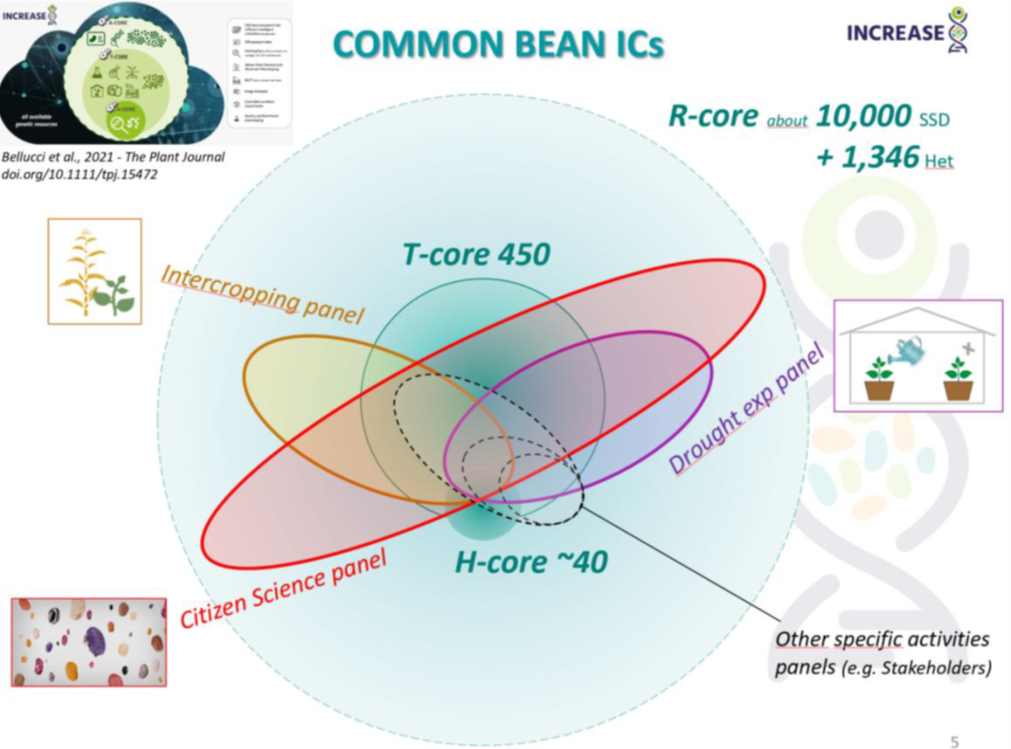
One of the main achievements of the project is the development of around 8,000 stable bean lines using a method called Single Seed Descent (SSD).
These lines:
- are genetically stable and well-documented (genomic sequences and passport data)
- represent a wide range of bean diversity
- form the basis of structured core collections (R-core, T-core, H-core).
This makes bean genetic resources easier to conserve, study and exploit, not only in breeding.
Large-Scale Field Testing Across Europe
From 2021 to 2026, the INCREASE team tested beans in six European countries under different environmental conditions.
Researchers collected:
- Field performance data from multiple locations (under different environmental and climate conditions across EU: e.g. Spain, Italy and Poland, in two different years)
- Information on yield, stress response and several plant traits
- Nutritional and quality characteristics
- Data on interactions with beneficial soil bacteria (rhizobia)
All data were collected using standardised protocols to ensure consistency and high quality and providing tools and protocols to the scientific community.
Advanced Genetic Research
INCREASE generated one of the most comprehensive genetic datasets ever produced for common bean.
This includes:
- Whole-genome sequencing of hundreds of lines (WGS data for more than 650 lines)
- Genotyping of thousands of additional lines (GBS data for more than 5,500 lines)
- Development of a common bean pangenome (a complete overview of genetic diversity across varieties)
- Sequencing of the ancient DNA of 12 historical herbarium bean samples from the 1700s to study the evolution of genetic diversity
These resources help researchers better understand bean diversity, domestication and adaptation.
Focus on Climate and Sustainability
The INCREASE project also studied:
- Drought tolerance
- Plant responses to biotic stresses (diseases and pests)
- Performances in intercropping systems (e.g. maize-bean combinations)
- Genetic markers linked to important adaptive and agronomic traits
This knowledge supports the development of beans that are more resilient to climate change and suitable for sustainable farming.
Working with Stakeholders and Breeders
To extent its impact, INCREASE collaborated with:
- Genebanks
- Universities and research institutes
- Breeders
- International partners
- Nordic and Mediterranean bean collections
Breeders can now test and use selected lines to develop improved varieties. Genebanks benefit from better conservation and management tools.
Citizen Science: Beans in the Hands of the Public
A unique feature of INCREASE is its Citizen Science experiment.
Citizens:
- Received bean seeds
- Grew them in gardens, balconies, schools and fields
- Recorded observations using a dedicated app (INCREASE CSA)
- Shared photos and experiences
- Exchange seeds.
This decentralised approach supports conservation, increases awareness, supports education of young generation and connects science with society.
Ongoing Research and Publications
Data analyses are still ongoing, including:
- Genetic diversity studies
- Genotype-Environment interactions
- Identification of genes and genomic regions with adaptive and agronomic effects
- Multi-omics research (combining genomics, metabolomics, transcriptomics)
- AI-supported analysis of citizen-generated data
Several scientific papers have already been published and more are in preparation.
Long-Term Impact
The INCREASE common bean results will continue to benefit:
- Genebanks, through improved conservation methods
- Researchers, through open data and collaboration
- Breeders, through access to valuable genetic material
- Farmers and citizens, through participatory conservation
- European agri-food systems, through stronger crop diversity and resilience towards sustainability
Overall, INCREASE has made its mark and created a strong foundation for the sustainable use and conservation of common bean genetic resources in Europe.